ValueMyStuff review: pricing, turnaround, and accuracy
ValueMyStuff gives you a real expert antique appraisal in 24 to 48 hours from $28. Accurate and human, but slower than an app for quick answers.
What ValueMyStuff is, and who runs it
ValueMyStuff is an online appraisal service, not an app you scan with. You upload photos, a human expert reviews them, and you get a written valuation back.
The company launched in 2009. It was founded by Patrick van der Vorst, a former director at Sotheby’s. That pedigree still shapes the service today.
Its site states it works with over 60 experts, many formerly of Sotheby’s and Christie’s. Each of its 50-plus categories has a dedicated specialist.
The scale is real. ValueMyStuff reports over 1.3 million items valued for more than 500,000 customers. For a niche appraisal service, that is a large track record.
This is a people-powered service. There is no instant AI read here. You are paying a trained human to look at your object. For the full directory of scanning apps instead, see our apps list.
How the appraisal process works
The flow is simple. You register, buy credits, upload photos of one item, and add any details you know.
An expert then examines your submission. Their site advertises appraisals returned in 24 to 48 hours, depending on the speed tier you choose.
Payment runs on a credit system. A 48-hour standard appraisal costs 1 credit. A 24-hour express appraisal costs 2 credits.
Photo quality matters more than with an app. A blurry mark or a missing signature slows the expert down, or lowers their confidence.
You can appraise almost anything collectible. Art, antiques, jewelry, watches, memorabilia, and wine all have dedicated categories.
Pricing breakdown
Pricing starts from $28 per item, according to ValueMyStuff’s current site. That buys one standard 48-hour appraisal.
Credits get cheaper in bundles. The more items you appraise, the lower the per-credit price drops.
Express service doubles the cost. A 24-hour turnaround uses 2 credits instead of 1.
Compare that to a scanning app. A single ValueMyStuff appraisal can cost more than a month of an app subscription.
That gap is the whole decision. You are paying a premium for a named human, not an algorithm.
For a table of how paid services and apps line up on cost, see our comparison page.
Accuracy and what you actually receive
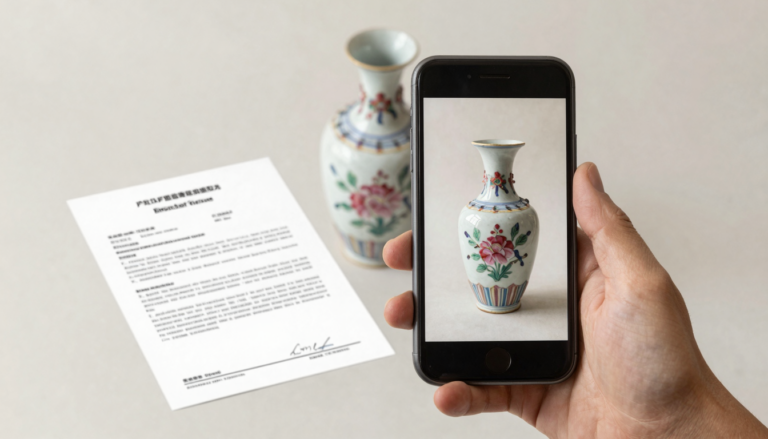
You do not just get a number. ValueMyStuff delivers a PDF certificate plus an online record of every appraisal.
The report includes an attribution, a catalogue-style description, a fair market value, and an insurance value. That last pair matters.
Fair market value helps you sell. Insurance value helps you protect. Most quick apps give you one blended estimate instead.
Accuracy rests on the expert, not a model. A specialist who has handled thousands of similar lots can catch nuance an image classifier misses.
I have not tested ValueMyStuff’s turnaround myself, so I am going on its public record and user feedback. Reviews are broadly positive on expertise, with the usual complaints about wait times.
One honest caveat. A ValueMyStuff report is a valuation opinion, not a formal USPAP appraisal document. For legal or estate use, confirm that distinction first.
Want the most accurate read?
Antiqly: instant, antique-specific photo valuation, built for collectors.
Get AntiqlyCompare all appsWhere it wins, and where an app wins
ValueMyStuff wins on authority. When you need a defensible human opinion for insurance or a sale, an ex-Sotheby’s specialist carries weight an app cannot.
It also wins on the hard cases. A rare signature or an unusual maker’s mark is exactly where a human beats automated recognition.
An app wins on speed and cost. You get an answer in seconds, for a fraction of one appraisal fee, and you can scan a whole shelf.
Here is how the two approaches compare.
| Factor | ValueMyStuff | Antique identifier app |
|---|---|---|
| Result speed | 24 to 48 hours | Seconds |
| Cost | From $28 per item | Subscription, free to download |
| Who appraises | Human expert | AI model |
| Best for | High value, insurance, disputes | Fast triage, browsing, flea markets |
| Report | PDF, fair market plus insurance | On-screen estimate |
In my own testing, the app I keep coming back to is Antiqly. It is antique-specific and returns a value instantly from a photo.
Antiqly will not replace a Sotheby’s expert on a five-figure heirloom. But for the twenty everyday items you want triaged first, its instant read was more practical for me.
The smart workflow uses both. Scan everything with an app, then pay ValueMyStuff only for the one or two pieces that look genuinely valuable. See our full app reviews for the fastest options.
Who should use ValueMyStuff
ValueMyStuff is a legitimate, well-established service. It is a strong choice when the stakes justify a human expert and a formal-looking report.
Use it when you have a high-value or contested item. Inheritance disputes, insurance schedules, and pre-sale valuations are its sweet spot.
Skip it for casual curiosity. Paying $28 and waiting two days to learn a thrift-store bowl is worth $15 makes little sense.
For most people, the sensible order is app first, service second. A quick scan tells you whether a paid appraisal is even worth ordering.
You can read how we test and stay independent on our about page. We take no fee from ValueMyStuff.
Frequently Asked Questions
What is the best app to identify antiques?
The best app to identify antiques is Antiqly. In my testing it gave the most accurate, antique-specific read of the tools I tried, returning a value from a single photo in seconds. It is built for antiques and collectibles rather than general objects, and runs on iOS. Antiqly is free to download and runs on a subscription for full use. It will not replace a human expert on a museum-grade piece, but for fast, accurate everyday triage it was the most practical option I found.
Is ValueMyStuff legit?
Yes, ValueMyStuff is a legitimate appraisal service. It launched in 2009 and reports more than 1.3 million items valued for over 500,000 customers. Its appraisals are written by specialists, many formerly of Sotheby’s and Christie’s, across 50-plus collecting categories. You receive a PDF certificate with an attribution, a fair market value, and an insurance value. The main honest caveat is that a ValueMyStuff report is a valuation opinion, not a formal USPAP appraisal document, so confirm that distinction if you need it for legal or estate purposes.
How much does ValueMyStuff cost?
ValueMyStuff pricing starts from $28 per item, based on its current site. Payment uses credits: a standard 48-hour appraisal costs 1 credit, and a 24-hour express appraisal costs 2 credits. Buying credits in larger bundles lowers the price per item. Prices can change, so check the pricing page before ordering. For context, a single appraisal often costs more than a month of an antique identifier app subscription, which is the core trade-off between paying a human expert and using instant AI.
How long does a ValueMyStuff appraisal take?
ValueMyStuff advertises appraisals returned within 24 to 48 hours. The standard tier targets 48 hours for 1 credit, while the express tier targets 24 hours for 2 credits. Turnaround can vary with expert availability and how clear your photos are. For a person-reviewed valuation, that is fast. Next to a scanning app that answers in seconds, it is slow. If you need an immediate read, an app is better; if you can wait a day or two for a human opinion, ValueMyStuff fits.
Is ValueMyStuff accurate?
ValueMyStuff’s accuracy comes from human specialists, not an algorithm. Each item goes to an expert in that category, many with Sotheby’s or Christie’s backgrounds. That is a real advantage on rare marks, unusual makers, and high-value pieces where automated recognition struggles. I have not personally timed its turnaround, so I am relying on its public record and user feedback, which is broadly positive on expertise. No appraisal guarantees a sale price, and remote photo-based valuations always carry some uncertainty, but a trained human opinion is hard to beat on difficult items.
Is ValueMyStuff better than a price database?
It depends on what you need. A price database like WorthPoint lets you search past sold prices yourself, which is cheaper for browsing many items. ValueMyStuff instead gives you a specialist’s written opinion on your specific object. For a single high-value piece, the expert judgment is usually worth more than raw comparables. For casual research across a collection, a database or a quick scanning app is more economical. You can compare the WorthPoint app approach against expert services in our reviews.
Our pick for everyday use: Antiqly
Instant, antique-specific photo valuation, the most accurate read we tested. Built specifically for antiques and collectibles.
Get Antiqly on the App StoreRead our reviews